
Using cellphone data to study human behaviors

I was listening to the Technology Podcast from the NPR that relates results of a study from Laszlo Barabasi, a human behavior researcher from Northeastern University. Laszlo negotiated access to full blind data from 50,000 cellphones subscribers to study their travelings and movements throughout a defined period (all cellphone signals transit through nearby cellphone towers, enabling the tracking).

The key finding is the extremely high percentage of predictability in day-to-day patterns. On average, he was able to see a 93% rate of predictability. That means that in 93% of the cases, you could in theory predict where that specific user would be. A lot of us might tend to believe that we’re fairly diversified creatures but when it comes to daily patterns, you’re pretty much the same as the one sitting next to you in the subway.

But what caught my attention was that phrase from Laszlo:

“We were seeing an average of 93 percent predictability across the user base. What does it mean? That means that for the vast majority of the people, you could, in principle, write an algorithm that could predict 93 percent of the time, correctly, their present location.

Now imagine what you could do with that, once your algorithm is build and you don’t have to rely anymore on actual data (hence getting rid of the immediate issues of privacy, data collection and storage and other Big Brothers driftings). The services you can bring to any organization managing large infrastructures, being it roads, trains, subways, local development etc. If somebody could convince carriers to open all anonymous and blind data through an APIs and let the hordes of developers coming up with applications on top of it, it would probably spur a great deal of innovative services.

The full 4 minutes of the interview are there.
The new definitions of privacy on the web

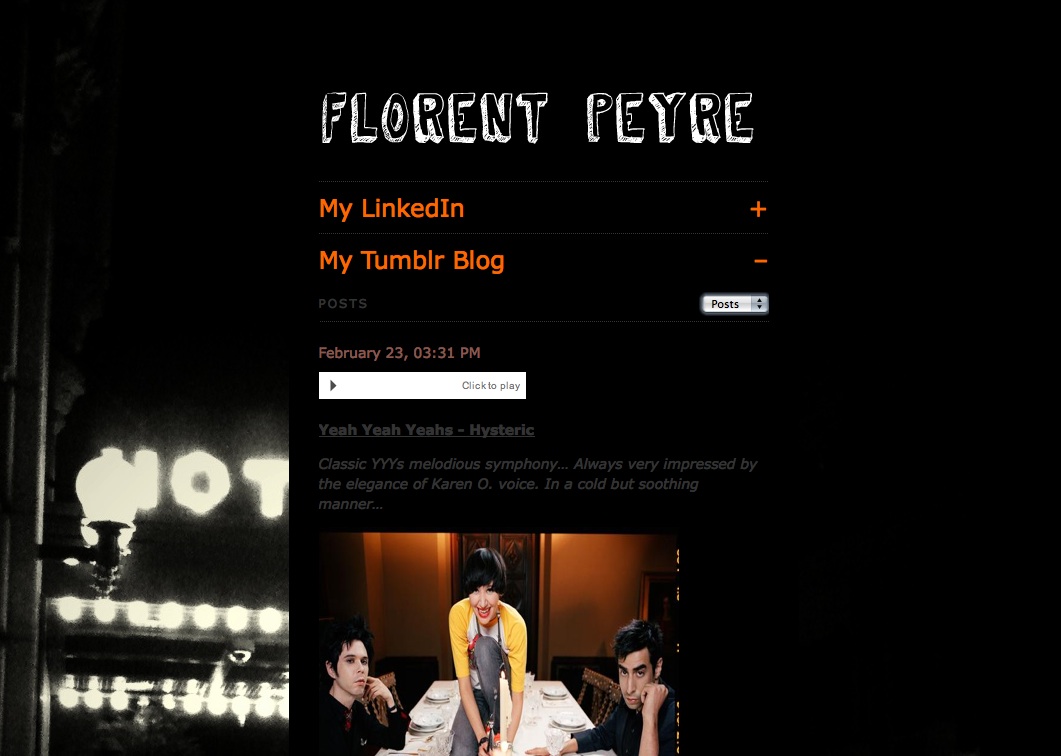
My Flavors.me Homepage with my Tumblr Blog Feed opened

Upon the sharing of a friend on Facebook (ahhh… the power of social recommendation…), I discovered a new service called  in Flavors.me which enables anyone to build a personalized page on himself or anyone else and then link to it the main social content production factories. They currently carry 14 services including Facebook, Tumblr but also your DVD queue from Netflix, your checkins from Foursquare or the last tracks you’ve been listening on Last.fm.
Once you’ve added all services, the user coming to your page can click on the services you’ve added and a window will display whatever stream of activity you’ve had on that specific service.
Testing it yesterday, I mechanically added all the services I’m using including Netflix and Foursquare. Once I realized that everybody could then follow my physical traces around NY through Foursquare or all photos that I posted to Facebook (and where these only get displayed to a selected list of people), I freaked out and decided to limit that to only the safer LinkedIn and other Twitter feeds.

Well, boy, it was easy to add services but it was a nightmare to remove them. Flavors.me doesn’t include a “Remove The Service” option… Sure, they’re in beta but given the nature of their business, that should probably be part of your MVP feature… So then I went to all the services I wanted to get off my Flavors.me page and remove the authorization for Flavors.me to access these data. But even with that, Flavors.me kept the latest stream of data imported. Sure, nothing new was going to get published but all of the content previously imported was visible.

I ended terminating my account at Flavors.me to clean it. Don’t get me wrong, I think the service is pretty neat (rebuilding a page right now), but I was a little taken aback by the difficulty to keep track of all your social traces. That comes around a fairly large debate, initially provoked by the launch of PleaseRobMe which list empty homes by tapping into Twitter API. While Foursquare is a closed network (you need to approve your friends), more and more people link it automatically with their Twitter account which is an open network, all of a sudden revealing to anyone who wants to find it whether you’re at home or not. Foursquare countered back on that issue but this is just the beginning of more and more debates around open systems.

One of the key improvements there would probably be for the main companies that offers to link your accounts to open systems like Twitter to state clearly that you pushing out data on the open. I also think that the details of permissions given to 3rd-party services should be much more detailed on networks like Facebook and Twitter. You basically should be able to have the same detail of what you’re authoring and to whom as you have in your Facebook privacy settings. For once, I might be pretty ok (actually I know I would…) to display on Flavors.me my Foursquare badges, but not necessarily all my checkins…

The photo above shows my welcome screen on Flavors.me with my Tumblr blog feed open

Reblog this post [with Zemanta]